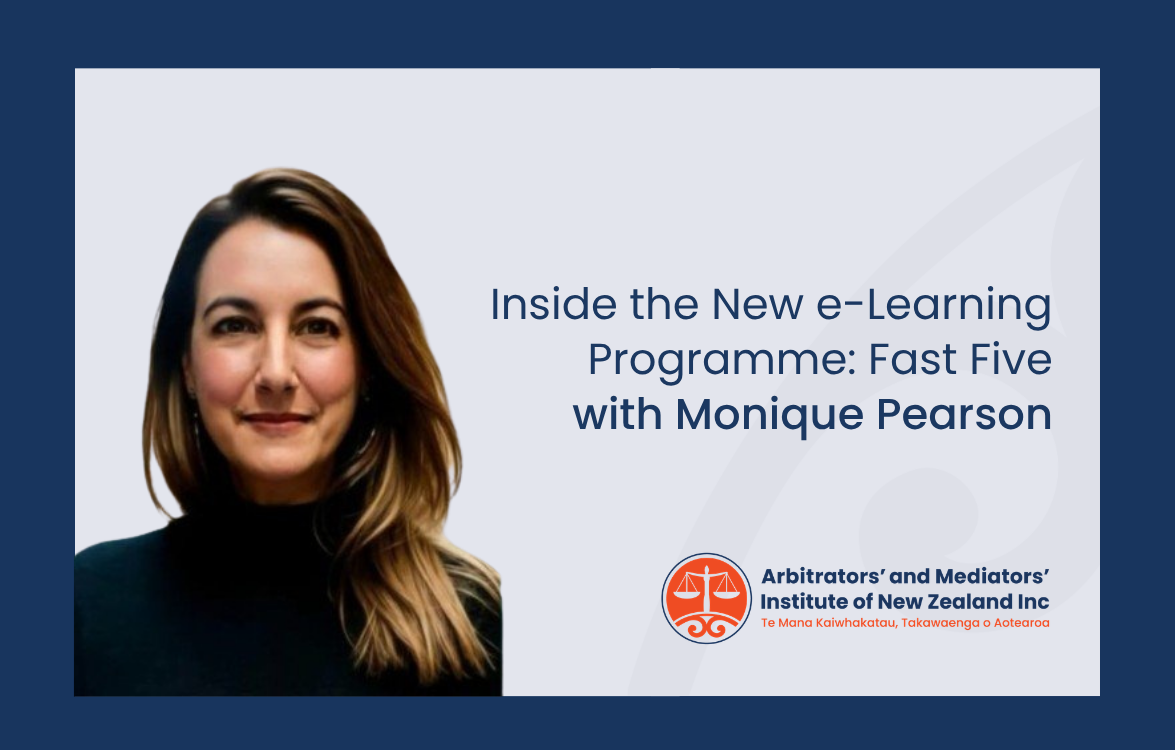
Inside the New AMINZ e-Learning Programme: Fast Five with Monique Pearson
AMINZ is delighted to announce its new e-Learning Programme: offering flexible, year-round learning that complements our existing education programmes and specialist practice days.
Executive Director Monique Pearson developed the programme and talks to us about the thinking behind the new model, the professional development needs it is designed to meet, how the four-stream framework was developed, how member feedback will shape the programme as it develops, and what she hopes members will get from the programme that they can take directly into their professional practice.
Kia ora Monique, what was your thinking behind developing a year-round e-Learning Programme for AMINZ members?
Dispute resolution is constantly evolving, and I wanted us to think more deliberately about how AMINZ helps members keep pace with that change throughout the year.
We have offered webinars and online learning for some time, but I saw an opportunity to develop a more deliberate, structured approach to year-round professional learning for our members. The idea is to give members regular opportunities to update their knowledge, hear new perspectives, explore emerging areas of practice and keep developing their skills, while complementing AMINZ’s flagship education programmes and specialist practice days.
People also learn in different ways, and not every piece of professional development needs to be a full-day course or conference. Practitioners are busy. Sometimes a focused 45 or 60-minute session, a useful article, a practical resource or some recommended reading is exactly what someone needs. I wanted the programme to make that kind of learning easier to access, to create more opportunities for small, regular pieces of learning throughout the year and, importantly, to make that learning available to members as part of their membership.
What gap were you hoping the new programme would fill for dispute resolution professionals?
There’s an enormous amount of information available to practitioners, both here and internationally, and it can be challenging to keep across what’s most relevant.
I think AMINZ has an important role in helping members navigate that by bringing useful developments, new thinking, practical issues and resources to the professional community in a way that’s accessible and relevant.
It’s also about looking beyond technical knowledge. Good dispute resolution practice draws on a wide range of capabilities: understanding people and behaviour, working effectively across cultures, responding to new technology, maintaining practitioner wellbeing and keeping up with changes in the profession and the sectors in which our members work.
The programme gives us a way to bring those different aspects of practice together in a more thoughtful and consistent way, rather than simply offering individual sessions as opportunities arise.
How did you arrive at the four content areas — Human Dynamics and Wellbeing, Intercultural Fluency, Future Practice, and Practice and Sector Updates?
The four areas came from what we were hearing and observing across the dispute resolution community: member enquiries, professional conversations, emerging practice issues, international developments and approaches from people with interesting expertise and ideas to share.
I wanted a framework that reflected the breadth of contemporary dispute resolution practice, rather than organising professional development solely around technical subject areas.
They also reflect what contemporary dispute resolution practice increasingly requires.
Human Dynamics and Wellbeing recognises that our work is ultimately about people, relationships and conflict, and that practitioner wellbeing matters too.
Intercultural Fluency reflects the importance of being able to work effectively across cultures, communities and different perspectives.
Future Practice looks at what is changing around us, including AI and technology, as well as areas such as communication, professional profile and building a sustainable practice.
Practice and Sector Updates will help members keep abreast of legislative, regulatory, technical and sector-specific developments.
Together, the four streams give us a balanced framework and they’re deliberately broad enough to evolve. We want to be able to respond when something new emerges or when there’s an issue members need to know about.
How will member feedback shape the programme as it develops?
Member feedback will be central to how the programme develops.
We will look at the formal feedback we receive after sessions and also at what people choose to attend, what they access through the Member Portal, the questions members are asking us and the issues we see emerging in practice.
I would like members to feel that this is their programme too. If there is an issue they are encountering in their work, an area they want to understand better, an international development we should be looking at, or someone they think the wider community would benefit from hearing from, we want to know.
The programme needs to keep evolving. We don’t want to simply set a calendar at the beginning of the year and assume we have got it right. It should remain responsive to the profession and to what our members need.
What do you hope members will get from the programme that they can take directly into their professional practice?
I hope members regularly come away with something useful: a new idea, a different perspective, an update they needed to know about, a practical tool or resource, or something that makes them stop and think about their own practice.
Not every piece of learning needs to be transformational. There is real value in bite-sized learning and in small, regular pieces of professional development that build knowledge and capability over time.
More broadly, I hope the programme helps our members stay current, curious and confident in their practice. AMINZ has an important role in supporting the dispute resolution community, and part of that is helping members keep abreast of developments here and internationally and giving them access to contemporary thinking, useful resources and good practice.
If we can make high-quality professional learning easier to access, easier to absorb and easier to apply in day-to-day practice, then I think the programme will be doing exactly what it was intended to do.
Learn more about e-Learning Programme and register for our upcoming sessions here.